
Krypton CW Arc LampKrypton CW Arc Lamp
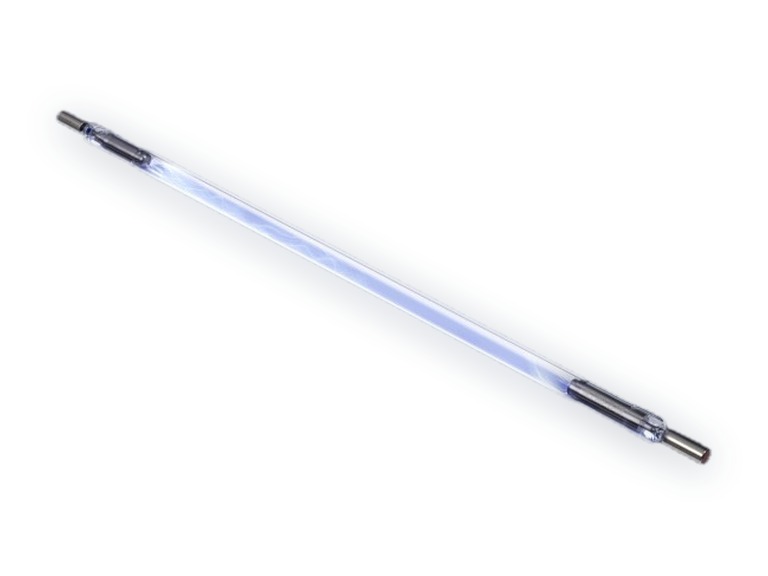
The krypton CW arc lamp is a high-performance gas discharge source designed for continuous-wave solid-state laser pumping. Unlike pulsed xenon flash lamps, these lamps emit continuous, stable radiation in constant DC mode, delivering efficient optical pump energy to Nd:YAG lasers with a spectrum closely matched to the crystal absorption band.
Key Features
Well-matched spectrum: strong emission from 750 – 900 nm overlapping the main Nd:YAG absorption band for higher pump efficiency
High-pressure design: operates at 4 – 8 atmospheres (set by the required lamp voltage); high fill pressure improves electrical-to-optical efficiency
Patented cathode technology: cathodes are made in-house with advanced pressing and sintering, modified tungsten bodies, optimized density and a range of backfill methods — challenging conventional lamp life benchmarks
Precision manufacturing and quality control: high-purity fused quartz envelopes, some models cerium-doped; tubes are strictly inspected for defects to ensure safe high-pressure operation; the engineering centre is equipped with X-ray and finite element analysis
Mechanical design: the glass envelope shrinks onto the electrode assembly, improving heat conduction at anode and cathode; thin-wall glass can be used in the arc region for extra cooling
Flexible supply options: constant-current or fixed-voltage supplies; modulation of CW (switching between sustaining and peak current for a few milliseconds) and quasi-CW (sinusoidal drive using the mains frequency) are supported
Applications
| Application | Description |
|---|---|
| High-power CW Nd:YAG laser pumping | Core application — continuous, stable pump energy |
| Research and industrial processing | Materials processing, laser cutting, laser welding |
| Solar simulators | Stable, high-intensity continuous test light source |
| Airport runway lighting | High-reliability specialty lighting |
Specifications

| Model | Bore (mm) | Arc (mm) | Body length (mm) | Total length (mm) | Design current (A) | Maximum design voltage (V) | Power (W) | Static impedance (Ω) |
|---|---|---|---|---|---|---|---|---|
| A | 4 | 51 | 191 | 191 | 20 | 110 | 2200 | 5.5 |
| B | 4 | 76 | 140 | 160 | 20 | 190 | 3800 | 9.5 |
| C | 4 | 99 | 167 | 167 | 20 | 200 | 4000 | 10 |
| D | 4 | 148 | 223 | 223 | 20 | 290 | 5800 | 14.5 |
| E | 5 | 50 | 154 | 154 | 30 | 86 | 2600 | 2.87 |
| F | 5 | 84 | 145 | 175 | 30 | 155 | 4650 | 5.17 |
| G | 5 | 102 | 160 | 194 | 30 | 180 | 5400 | 6 |
| H | 5 | 121 | 223 | 233 | 30 | 240 | 7200 | 8 |
| I | 6 | 101 | 165 | 200 | 35 | 175 | 6125 | 5 |
| J | 6 | 170 | 255 | 377 | 40 | 255 | 10200 | 6.38 |
| K * | 4 | 110 | 177 | 320 | AC | 4500 | — | — |
| L * | 5 | 160 | 225 | 400 | AC | 6500 | — | — |
| M * | 6 | 280 | 347 | 450 | AC | 1000 | — | — |
Operating Notes
Cooling: pulsed and DC-pumped Nd:YAG lasers require liquid cooling; inadequate cooling shortens lamp life and causes unstable operation
Factors affecting lamp voltage: operating current, envelope bore, arc length, gas pressure and dead volume
Polarity: DC-operated lamps are polarity sensitive; AC lamps are non-polarized
Customization: most lamp types are custom products and can be engineered to your application