
S2 High-OH Synthetic Quartz TubeS2 High-OH Synthetic Quartz Tube
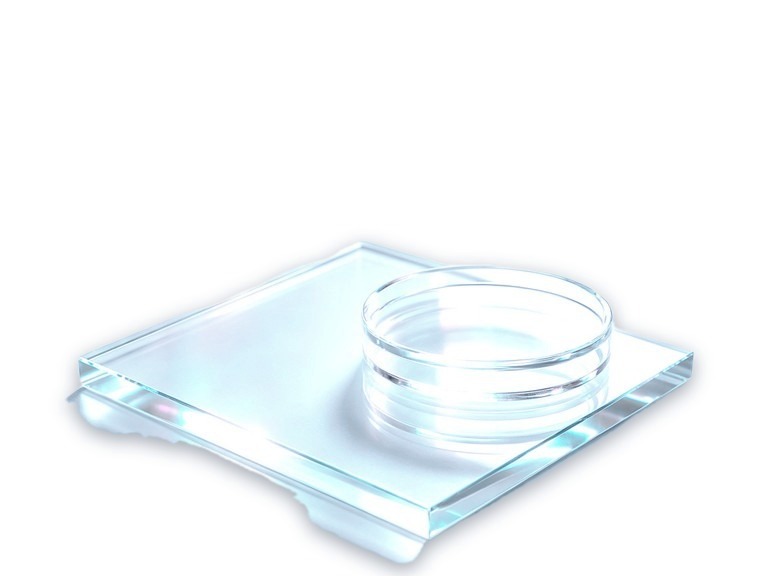
S2-series synthetic fused silica is produced with a unique, environmentally friendly fusion process, offering very high purity and excellent visual quality. It is a fused silica glass with high transmittance, performing well in high-energy and deep-UV applications. The S2 series is free of bubbles and inclusions; its ultra-high purity gives excellent optical transmission across the deep-UV and visible bands, with an effective wavelength range extending from below 180 nm to 2000 nm.
Application Scenarios
| Application field | Specific application scenarios | Key advantages |
|---|---|---|
| Semiconductor and microlithography | Lenses and photomask substrates in lithography equipment. | This is its most critical application. At the 193 nm (ArF) and 248 nm (KrF) excimer laser wavelengths, the material requires extremely high transmittance, very low absorption, excellent optical homogeneity and laser-damage resistance to ensure chip-process precision and long lens life. |
| High-energy lasers and optical systems | Optical components (such as windows and lenses) for excimer and high-power lasers, and components in beam-delivery systems. | The material withstands high-energy laser radiation and does not heat up or deform from absorbing laser energy, preserving beam quality. |
| Precision analysis and spectroscopy | Cuvettes and optical windows in spectrophotometers and key parts of spectrometers. | Broadband high transmittance from deep UV to near infrared makes it an ideal window material for precision optical analysis. |
| Emerging technologies | Deep-UV photochemical microreactor chips and high-precision microfluidic devices. | For example, scientists used its deep-UV transmittance to fabricate three-dimensional microreactor chips for efficient synthesis of drugs such as vitamin D3, solving the absorption and thermal-management problems of conventional equipment under UV light. |
| Telecom and specialty fiber | Core or cladding material for high-performance, light-guiding and specialty fibers. | Very low signal loss and stable optical performance underpin its use in fiber communications. |
In addition, its high-temperature and thermal-shock resistance means it is often used as a substrate for optical components with extremely demanding stability requirements, or as a specialty part.
Appearance Parameters
| Striae | Functional direction grade 5 (ISO 10110-4) |
|---|---|
| Birefringence / residual stress¹ | ≤ 5 nm/cm (typical) |
| Bubbles | Bubble grade (DIN 58927) 0 |
| Maximum number of inclusions² | 0 |
| Fluorescence³ | None (excited at 254 nm) |
Notes
¹ Stress-induced birefringence applies to an ingot diameter of 80% or a machined-part diameter of 90%.
² Bubbles and inclusions ≤ 80 μm in size are not counted. Products free of inclusions down to 10 μm are available on request.
³ Excitation source: Hg lamp, λ = 254 nm, UQ 5 filter; lamp power: 8 W; detection method: adapted to the human eye.
Optical Characteristics
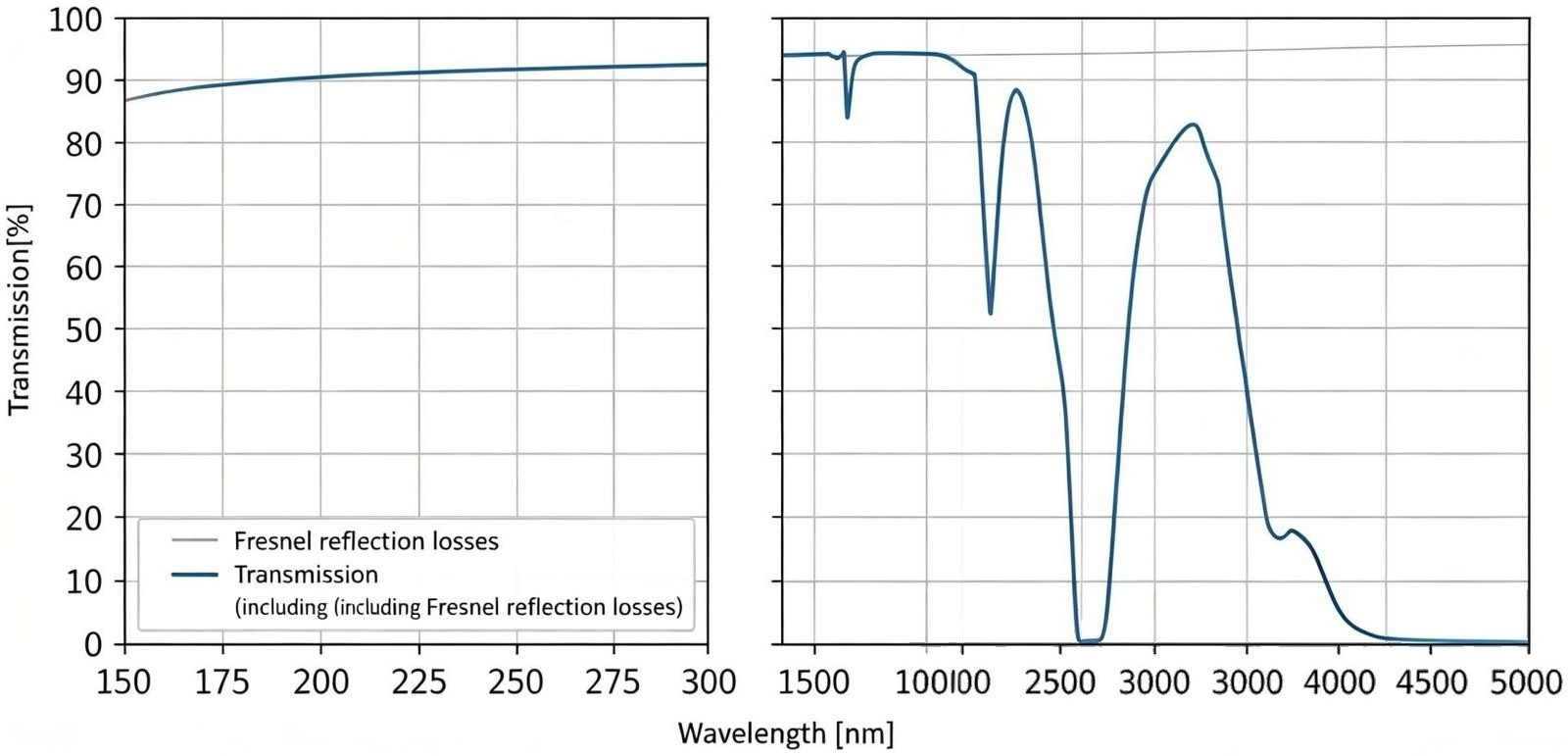
| Wavelength | Transmittance |
|---|---|
| λ = 193.4 nm | > 98.5% |
| λ = 248 nm | > 99.5% |
Typical Chemical Composition
| Hydroxyl (OH) content |
|---|
| ~1000-1350 ppm |
| Chemical properties | Element | Al | Ca | Cr | Cu | Fe | K | Li | Mg | Na | Ti | V |
|---|---|---|---|---|---|---|---|---|---|---|---|---|
| Content | <5 | <5 | <1 | <1 | <50 | <10 | <5 | <5 | <10 | <5 | <1 |
(Unit: ppm, i.e. μg/g)
Technical Performance
| Other properties | Thermal properties |
|---|---|
| Abbe number: 67.8 | Strain point*: 1025 °C |
| Density: 2.2 g/cm³ | Annealing point*: 1120 °C |
| Hardness: 5.5 ... 6.5 (Mohs) | Softening point*: 1600 °C |
| Coefficient of thermal expansion: 0.54 × 10⁻⁶ (average, K⁻¹, 0 ... 600 °C) |
* These values may vary with the thermal history of the glass.